
Seventy-One Billion Dollars and No Plan: What Should Gaza Be Rebuilt As?

The money to rebuild will eventually arrive. The question nobody is answering is what shape it should take.
In April 2026, the European Union and the United Nations, working with the World Bank, released the final Gaza Rapid Damage and Needs Assessment. It puts recovery and reconstruction needs at 71.4 billion dollars over the next decade, with 26.3 billion required in the first eighteen months alone.

That number has been reported widely. The question underneath it has barely been discussed.
Seventy-one billion dollars buys a great deal. It could buy two million people a roof each and nothing else. Or it could buy a place where those two million people can work, trade, study, and build something worth protecting.
These are not the same outcome. And the difference between them is not money. It is planning.
I want to make an argument that has nothing to do with who is right in this conflict. I have no standing to settle that question and I will not attempt it. My argument is narrower, and I think harder to disagree with:
A rebuilt Gaza that gives people shelter but no livelihood is not a solution. It is an interval between wars.
What we already know does not work
We have run this experiment before, in several places, including this one.
After the 2014 war, a large share of the destroyed housing in Gaza had still not been rebuilt when the next war began. What did get rebuilt was largely housing. Housing alone does not produce an economy.
A young man with a roof, no work, no prospect of work, and no ability to leave is exactly the raw material that every armed group in the world recruits from. This is not a moral claim about anybody. It is an observation about what idleness and hopelessness do to young men, and it holds in Gaza no differently from anywhere else.
You have to build the earning alongside the dwelling. Not after it.
What was actually destroyed
It is worth being precise about the economy that was lost, because most people imagine something quite different from the reality.
Gaza was never an oil economy or a port economy. It was a workshop economy — small and medium enterprises, family firms, light manufacturing and intensive agriculture. The exports were modest and specific: strawberries, cherry tomatoes, furniture and textiles, moved out by truck in small consignments.
And it was already failing before this war. UNCTAD recorded unemployment at 45 per cent in Gaza in 2022, with youth unemployment near 62 per cent. Two-thirds of the population lived in poverty. Eighty per cent depended on international aid. Real GDP was close to its lowest level since 1994.
What has happened since is of a different order. UNCTAD reports that Gaza's economy collapsed by 83 per cent in 2024, GDP per capita fell to 161 dollars — among the lowest figures recorded anywhere in the world — inflation reached 238 per cent, unemployment reached 80 per cent, and the entire population fell below the poverty line. By April 2025, around 70 per cent of all structures had been damaged.
The final assessment counts 371,888 housing units destroyed or damaged, more than half of hospitals non-functional, and nearly all schools destroyed or damaged. The UN and EU state that human development in Gaza has been set back seventy-seven years. Seventy-seven years. That is the number to hold on to.
So we are not restoring a working economy. We are being handed the rare and terrible opportunity to design one properly from the beginning.
What can actually thrive there
Gaza is 365 square kilometres holding roughly 2.3 million people. Movement of goods is restricted. Electricity is scarce. The groundwater is depleted and saline.
Any industry proposed for such a place must pass a hard test: high value per square metre, low imported raw material, low bulk when exported, low power draw, and many jobs per rupee of capital.
Apply that filter honestly and a short list survives.

Rubble. This is the strongest single answer, and almost nobody is discussing it. There are tens of millions of tonnes of debris lying on the ground. Crushing it into aggregate and pressing it into building blocks requires no imported raw material at all, which means no blockade can stop it. It is enormously labour-intensive. And it feeds directly into the reconstruction that has to happen anyway. The wreckage becomes both the employment programme and the supply chain.
Digital services. This sector ignores every physical constraint Gaza has. The population is highly literate and the universities produce graduates. Software, design, data work and remote services need only electricity and bandwidth. No crossing, no truck, no port. It scales one person at a time, which is exactly the pattern that already worked there.
Garments. Gaza had a substantial stitching industry historically. Low capital per job, small floor space, existing skills, and finished goods that travel in small volume.
Protected agriculture. Greenhouses, drip irrigation, hydroponics. Very high value per square metre, which is the binding constraint. Strawberries and cherry tomatoes already had proven buyers.
Solar. Strong sunlight, and installation and maintenance is a genuine trade. It also removes the electricity constraint that limits everything else on this list.
Food processing. Olive oil, tahini, dates, preserves. Adds value to whatever the land produces and serves the local market first.
Building trades. Demand guaranteed for a decade by the reconstruction itself.
None of these need a port. None need a gas field. All of them put money into ordinary hands rather than government hands, which is the entire point.
Now the harder question: What Should Gaza Be Rebuilt As?
Knowing which industries can survive is only half an answer. Where do you put them, and how do you lay out the place they sit in?
Here I want to bring in something from my own tradition, and I want to be honest about it as I do.
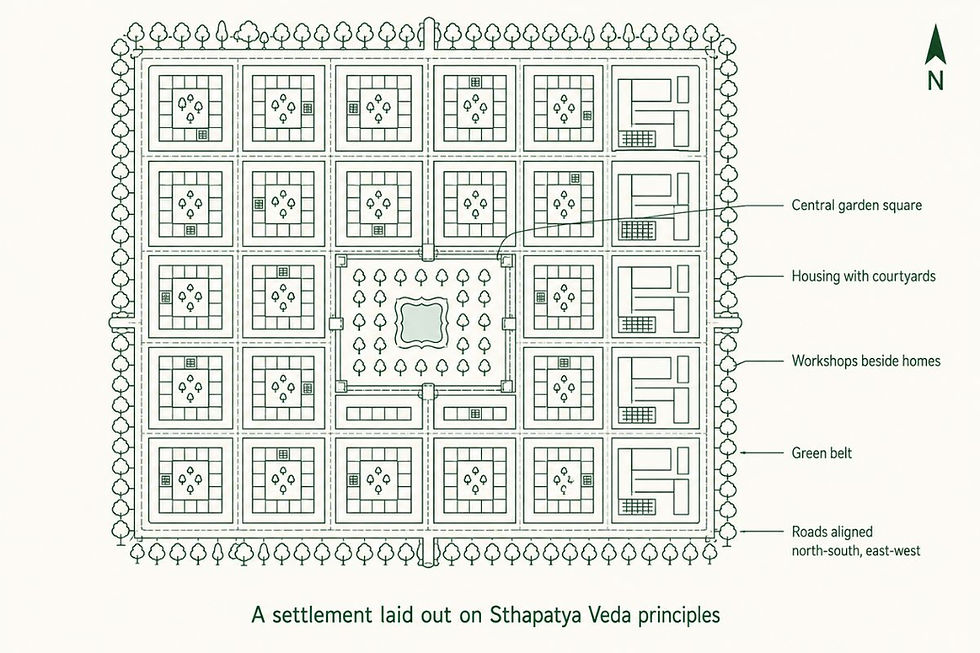
Maharishi Sthapatya Veda, the branch of Indian knowledge concerned with the planning of buildings and settlements, sets out a set of values for laying out an ideal community:
A site chosen for its environmental qualities — the slope of the land, the position of water, an unobstructed sunrise. Roads aligned north-south and east-west. An open central square with gardens. Low-density housing. Natural building materials and energy-efficient construction. Adequate flow of fresh air. Generous green space. Renewable, non-polluting energy. Proper proportion and placement for every building and amenity.
Read that list again and notice something. Most of it is not mystical at all. Orientation, cross-ventilation, shade, water placement, open space, natural materials, renewable power — this is climate-responsive design, described in Sanskrit centuries before anyone gave it that name in English.
Let me state the epistemic position plainly, because I would rather say it myself than have a reader say it for me.
Some of what Sthapatya Veda prescribes is measurable physics. A building oriented correctly in a hot climate is genuinely cooler, and you can put a thermometer in it and prove it. Other parts rest on inherited wisdom that has not been tested in a laboratory and perhaps never will be. I am not going to claim proof I do not have.
What I will say is this. These principles were refined over a very long period, in hot dry climates, by people who had no air conditioning and could not afford to be wrong. That is a form of testing, even if it is not the form a journal recognises.
The convergence that make this credible
Here is what makes this more than an Indian idea exported to Arab land.

The traditional Arab courtyard house — the hosh — is built around an open central space, exactly as Sthapatya Veda places its brahmasthan at the heart of a dwelling. Both traditions orient buildings to the sun and the prevailing wind. Both use thick natural walls against heat. Both place water where it cools the air moving into living space. Both grade space carefully, from public street to semi-private threshold to private interior. Both treat generous shaded greenery as essential rather than decorative.
Two traditions, separated by thousands of kilometres, answering to entirely different faiths, arrived at nearly the same answers.
That is not coincidence and it is not borrowing. It is what happens when serious people spend centuries solving the same problem — how do human beings live well in a hot, dry, water-scarce place — and independently reach the same conclusions.
This matters practically. Nobody in Gaza needs an Indian system imposed on them. They have their own, and it says much the same thing.

What both traditions are being displaced by is the twentieth-century default: the concrete block, oriented to the plot boundary rather than to the sun, with no courtyard, no cross-ventilation and no shade, air-conditioned at enormous cost where power exists and unbearable where it does not.
The refugee camps of Gaza are built in that idiom. So are large parts of Ahmedabad. Both are wrong for the climates they sit in.
Applying it to Gaza specifically
A few consequences follow if these principles are taken seriously.
Density is not the problem people assume. Our planning suggests a settlement of one square kilometre for roughly 6,250 people. Gaza's overall density, across the whole strip, works out at approximately 6,300 people per square kilometre.
That is essentially the same figure.

The crisis is not that too many people occupy too little land. It is that they have been compressed into a handful of camps and cities while other land sits restricted or unused. That is a distribution problem, and distribution problems are solved by planning.
Build several settlements, not one city. A network of planned towns, each with its own centre, its own gardens, its own working area, properly connected. Not one vast concentration.
Give each settlement an economic identity. A materials and construction town where the rubble lies heaviest. A digital and education district near the universities. An agricultural belt where the water and soil are best. A garments and light manufacturing quarter. When a town knows what it makes, suppliers cluster, skills accumulate, and training has an obvious destination.
Put the workshop next to the housing. Not an industrial zone twenty kilometres away requiring transport that does not exist. The traditional Arab town and the traditional Indian town both mixed work and living, and both were right to do so.
Design for no electricity. Orientation, thick walls, courtyards, shading and cross-ventilation make a building liveable when the power fails. In Gaza, the power will fail. This is not an aesthetic preference. It is survival planning.
Water first. Sthapatya Veda begins site selection with the position of water. Gaza's aquifer is over-extracted and saline. Any plan that does not begin with desalination, treatment and reuse is not a plan at all.

What this cannot do
I will not overclaim. None of this works without four things that are not architectural. Goods must be able to move. Power must be reliable. Water must be available. And there must be an authority stable enough that a contract can be enforced. No family will invest its savings in a workshop that may be rubble again in three years.
A well-planned town does not end an occupation, disarm a faction, or settle a claim to territory. Those questions belong to others, and they are far harder than mine.
But when they are eventually answered — and they will be, because such questions always are, eventually — somebody will have to decide what to build. That decision will be taken quickly, under pressure, by people with a budget and a deadline. If nobody has thought about it beforehand, the default will win. And the default is the concrete block.
It is worth noting that the EU and UN have themselves said recovery should be Palestinian-led and should follow what they call building-back-better and building-forward-better approaches. That is the official language for exactly this argument: do not rebuild what was there. Build something better designed.
The argument, finally
Seventy-one billion dollars is roughly the cost of putting this place back together after destroying it.
The same amount, spent with a plan, could produce a network of properly oriented towns, each with a working economy, each designed to remain liveable without power, each built partly from the rubble of what was destroyed, employing the very people who will live in them.
The difference between those two outcomes is not money. It is whether anybody thought about the shape before the concrete was poured.
That is a question India understands well. We have poured a great deal of concrete without thinking about the shape, and we are living in the result.
Pankaj Jain Kalyaan Foundation, Ahmedabad
Sources
Final Gaza Rapid Damage and Needs Assessment, European Union, United Nations and World Bank, 20 April 2026 — reconstruction and recovery needs, housing units damaged, hospital and school damage, 77-year human development setback.
UN Trade and Development (UNCTAD), November 2025 — 2024 economic contraction, GDP per capita, inflation, unemployment, poverty, share of structures damaged.
UNCTAD, October 2023 — pre-war unemployment, poverty and aid dependency figures for 2022.
United Nations Development Programme, May 2024 — pre-war youth unemployment.
Maharishi Sthapatya Veda planning principles as set out at vediccityplanning.com.


Comments