 Development
Indian cities are growing faster than they can be planned, and the result is sprawl, slums and traffic. This post proposes new economic-theme townships planned on Vaastu (Maharishi Sthapatya Veda) principles: roads on the four directions, a green central square, low density and renewable energy, sized from a 1 km² village to a 400 km² city.
We need to reconstruct the existing cities as well as develop new economic-theme Vaastu townships. We cannot follow the twentieth century metro models like Mumbai and Kolkata. A central city was existing previously and unplanned, un-structured development has started happening as the population exploded all over.
Humanity has reached a summit from where it is waiting to take a flight in space of higher consciousness. It is on the threshold of an inward journey to understand who we really are, and not merely to reinforce the sense of an artificially derived social identity, and with it comes a need for a different type of architecture which can create such true environments where this higher intelligence will blossom, the mind will act seated in consciousness and inner strength, man will be free from all selfish and egoistic movements and love will becomes the uniting thread for all humans.

Unplanned and unstructured growth
In 1900, only about 13% of the world’s population lived in cities. The United Nations projects that by 2050 the share will rise to 68%. By one popular estimate, the world adds the equivalent of seven New Yorks every year, and earlier estimates expected India to add about 22 crore (220 million) people to its cities between 2000 and 2025.
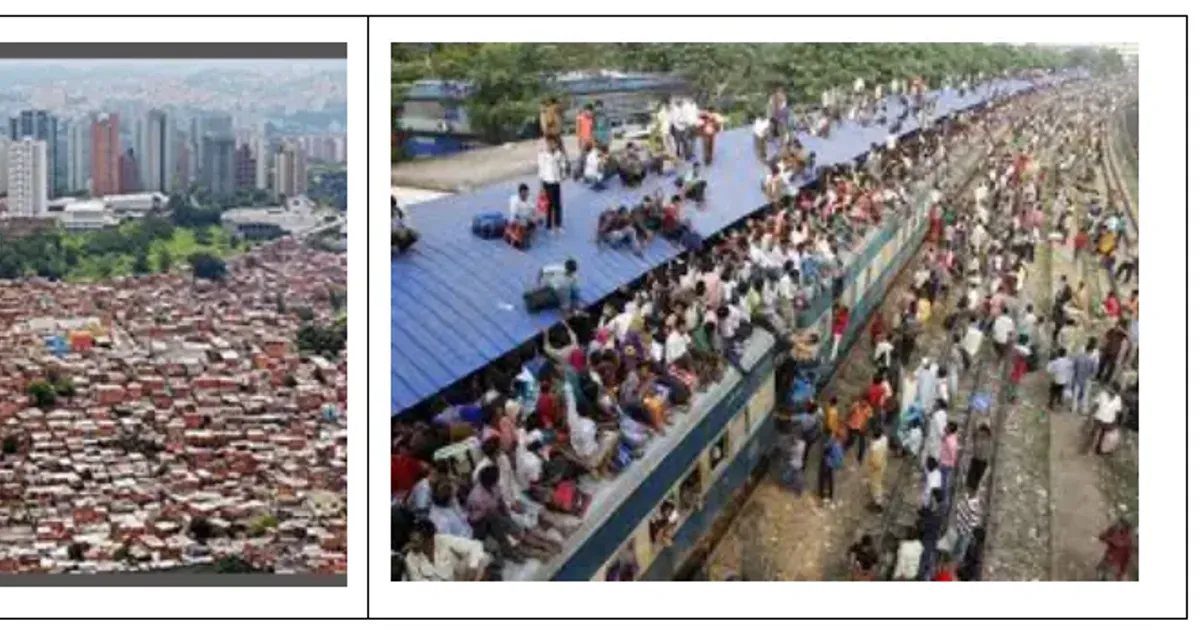
The country’s growth engine is clearly its urban areas. To accommodate the additional millions, India will have to add the equivalent of many Delhis, Mumbais or Bengalurus. How do we create this much of livable urban space or locate the resources and people needed to deliver it.
This unprecedented urbanization is both an emblem of our economic and societal progress - especially for the world’s emerging nations - and a huge strain on the planet’s infrastructure. It’s a challenge felt urgently by mayors, heads of economic development, school administrators, police chiefs and other civic leaders. The challenges these leaders face - educating the young, keeping citizens safe and healthy, attracting and facilitating commerce and enabling the smooth flow of planes, trains, cars and pedestrians.
Maharishi Mahesh Yogi’s Sthapatya Veda Vaastu Townships
Maharishi Mahesh Yogi’s sthapatya veda considers the following values in the planning and design of ideal communities - beautiful garden cities, in order to uphold healthy, happy life through the full support of natural law
Auspicious site considering environmental parameters ( Slope of the land, bodies of water, unobstructed sunrise, etc ) that maintain life in accord with natural law.
-
Layout of entrance of the city with direct orientation to the east
-
All roads aligned north / south, east / west
-
Open central square with gardens
-
Proper location and proportions of all buildings and amenities according to Vaastu Science.
-
Low density housing
-
Natural building materials and energy efficient construction
-
Adequate flow of fresh air
-
Generous green space
-
Solar, wind and other cost effective, renewable non polluting energies
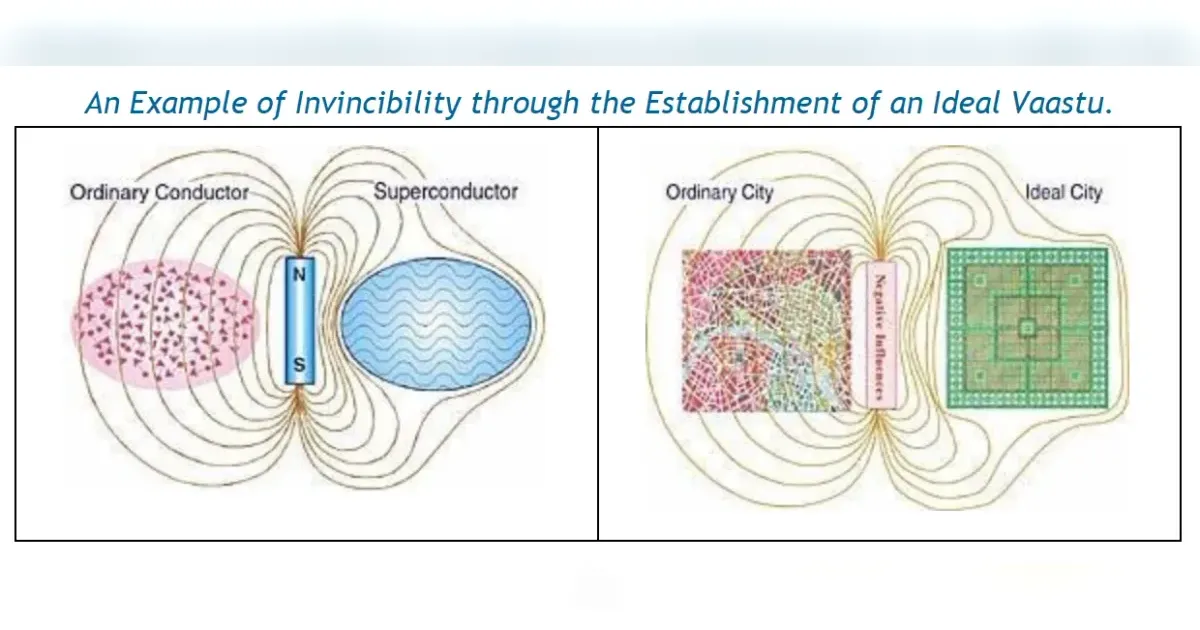
Ordinary city vs Vaastu city
Ordinary Conductor: In an ordinary electrical conductor, incoherent, disordered electrons allow penetration by an external magnetic field.
Super Conductor: In a superconductor, coherent collective function of the electrons spontaneously excludes an external magnetic field, and maintains its impenetrable status.
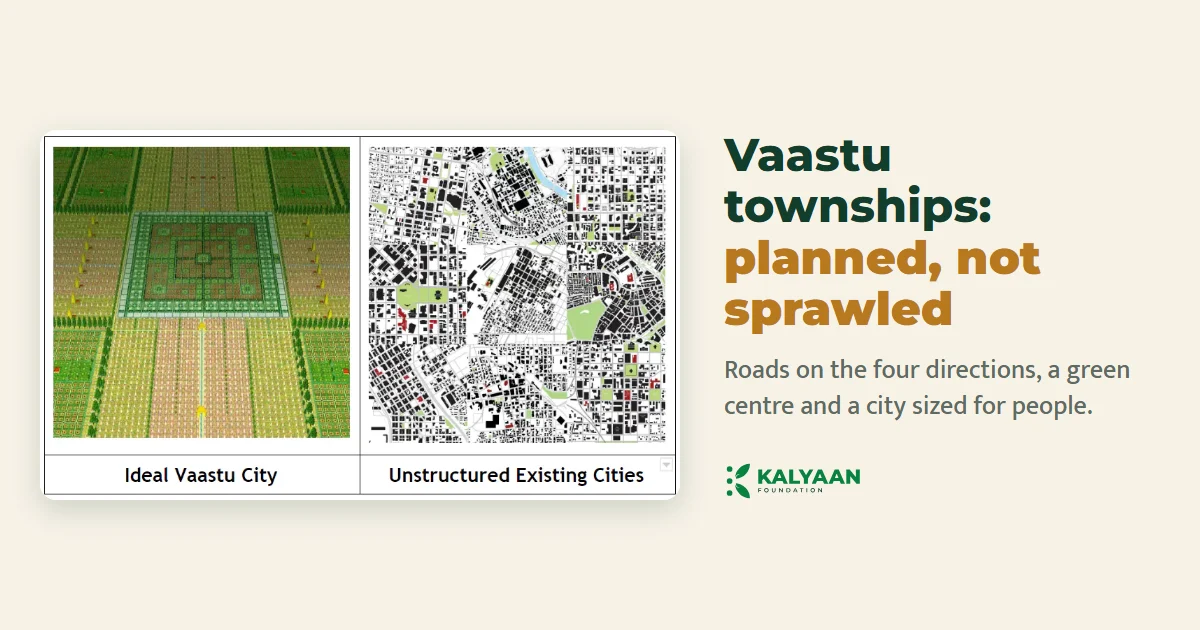
Ordinary City: In an ordinary city roads are running in all directions resulting in the improper, or distorted, orientation of buildings, which leads to chaos, problems, and violation of Natural Law in individual life and in society. Principles of invincibility are not unique to the Meissner Effect; parallels phenomena of invincibility can be found in many aspects of the physical and biological sciences. In each case, it is found that the ability of the system to resist disorder is always based on the coherent collective functioning of all its components.
Ideal Vastu City: In an Ideal City with an ideal Vastu—ideal orientation of buildings—all roads run north–south and east–west, creating cross-ventilation and enriching city life with the evolutionary power of Natural Law—creating order. The example of coherence and invincibility through the establishment of an ideal Vaastu is described in the ancient literature of Maharishi Sthapatya Veda. This Vedic literature maintains that by virtue of the internal orderly structure of the Vaastu, all negative influences have to remain at the outskirts of the city – beyond the Vaastu demarcation.
Ideal Vaastu townships for new generations
We need to reconstruct the existing cities as well as develop new economic theme based Vaastu cities. We cannot follow the twentieth century metro models like Mumbai and Kolkata. A central city was existing previously and unplanned, un-structured development has started happening as the population exploded all over.
Economic sectors like Automobiles, Ayurveda and Yoga, Finance, Garments, Software, Jewellery and Arts based many new Vaastu cities have to be built according to current and projected population growth. Twenty five lakh people (2.5 million) per city could be the ideal population of a city, which helps the people to live a peaceful, healthy and happy life. The size of a city or village can be as low as one square kilometer (Vaastu Village) or as large as four hundred square kilometers (Vaastu City)
Ideal size of Vaastu townships
| Size | Area | Population |
|---|---|---|
| 1 × 1 km (Vaastu village) | 1 km² (about 250 acres) | 6,250 |
| 2 × 2 km | 4 km² | 25,000 |
| 5 × 5 km | 25 km² | 1,56,250 |
| 10 × 10 km | 100 km² | 6 lakh |
| 15 × 15 km | 225 km² | 15 lakh |
| 20 × 20 km (Vaastu city) | 400 km² | 25 lakh |
Madhya Pradesh, one of India’s states, already had 7.26 crore (72.6 million) people in the 2011 Census. If we expect around three crore people to move to urban areas, then we may require twelve major cities each of 400 sq km to accommodate and provide all basic amenities to these people.
The government should establish a clear Vaastu-based city and township planning development strategy to control the unstructured growth occurring across the country. This approach would enable focused, well-distributed development throughout the region, creating multiple economic zones and providing enhanced employment opportunities for everyone.
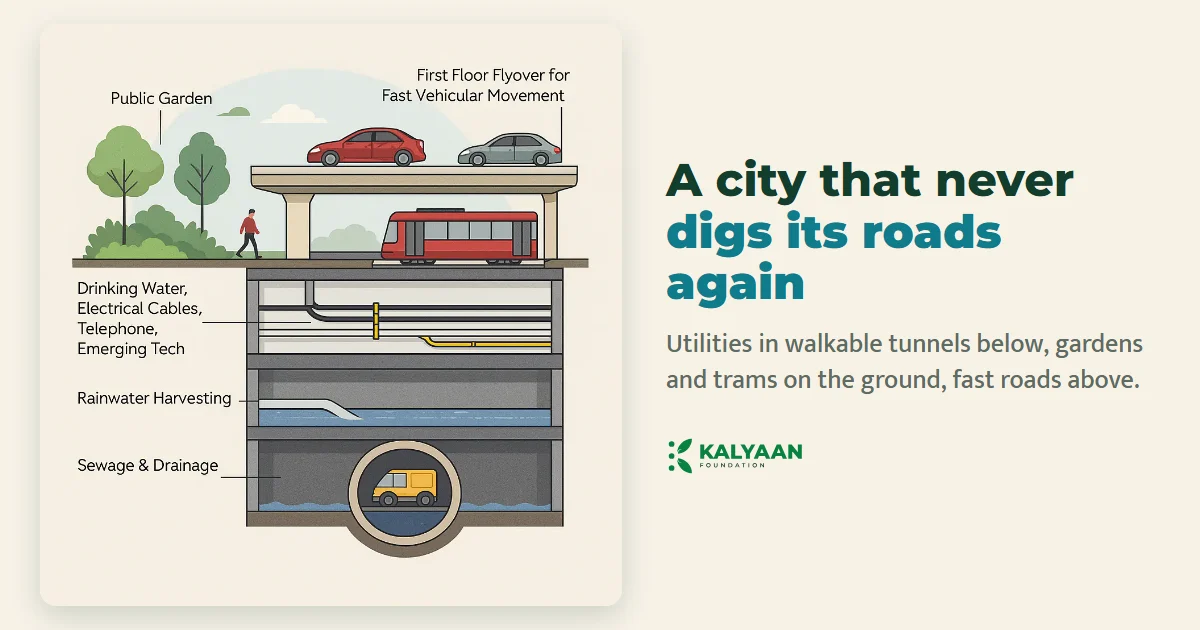
The same principles can guide reconstruction after disaster or war, as we argue in what Gaza should be rebuilt as, and they work best with modern multilayered city infrastructure.
Sources
- Maharishi Vedic City Planning, Sthapatya Veda principles, vediccityplanning.com, accessed 9 November 2026.
- United Nations DESA, World Urbanization Prospects: The 2018 Revision: 68% of the world population projected to be urban by 2050, population.un.org, accessed 9 November 2026.
- Census of India 2011: Madhya Pradesh population 7.26 crore.
Questions and answers
What is a Vaastu township?
A town planned on Vaastu, or Maharishi Sthapatya Veda, principles: roads aligned north–south and east–west, an east-facing entrance, an open central square with gardens, low-density housing, natural materials and renewable energy.
Why does India need planned Vaastu cities?
Because cities are growing without structure, creating slums, traffic and pressure on services. New planned townships, each with its own economic theme, can spread growth and jobs across the region.
What is the ideal size of a Vaastu city?
From a 1 km² Vaastu village of about 6,250 people to a 400 km² Vaastu city of about 25 lakh people, which the author suggests as the ideal city population.
Is Vaastu city planning scientific?
Parts of it, like orientation to sun and wind, cross-ventilation, shade and open space, are measurable climate-wise design. Other parts rest on traditional knowledge that has not been tested in laboratories.