 Environment
Singapore has almost no rivers, little land and no natural aquifers, yet its tap water is safe to drink and supply is reliable. This post explains Singapore's water management system, its Four National Taps, and the lessons Indian cities and villages can take from it.
Singapore is internationally recognised as a model city for integrated water management. A small island with almost no rivers and no natural aquifers, it has built one of the most secure water systems in the world. Here is how Singapore water management works, and what we in India can learn from it.
Three strategies behind Singapore’s water management
Singapore’s national water agency, PUB, follows three simple strategies:
- Collect every drop of water
- Reuse water endlessly
- Desalinate seawater
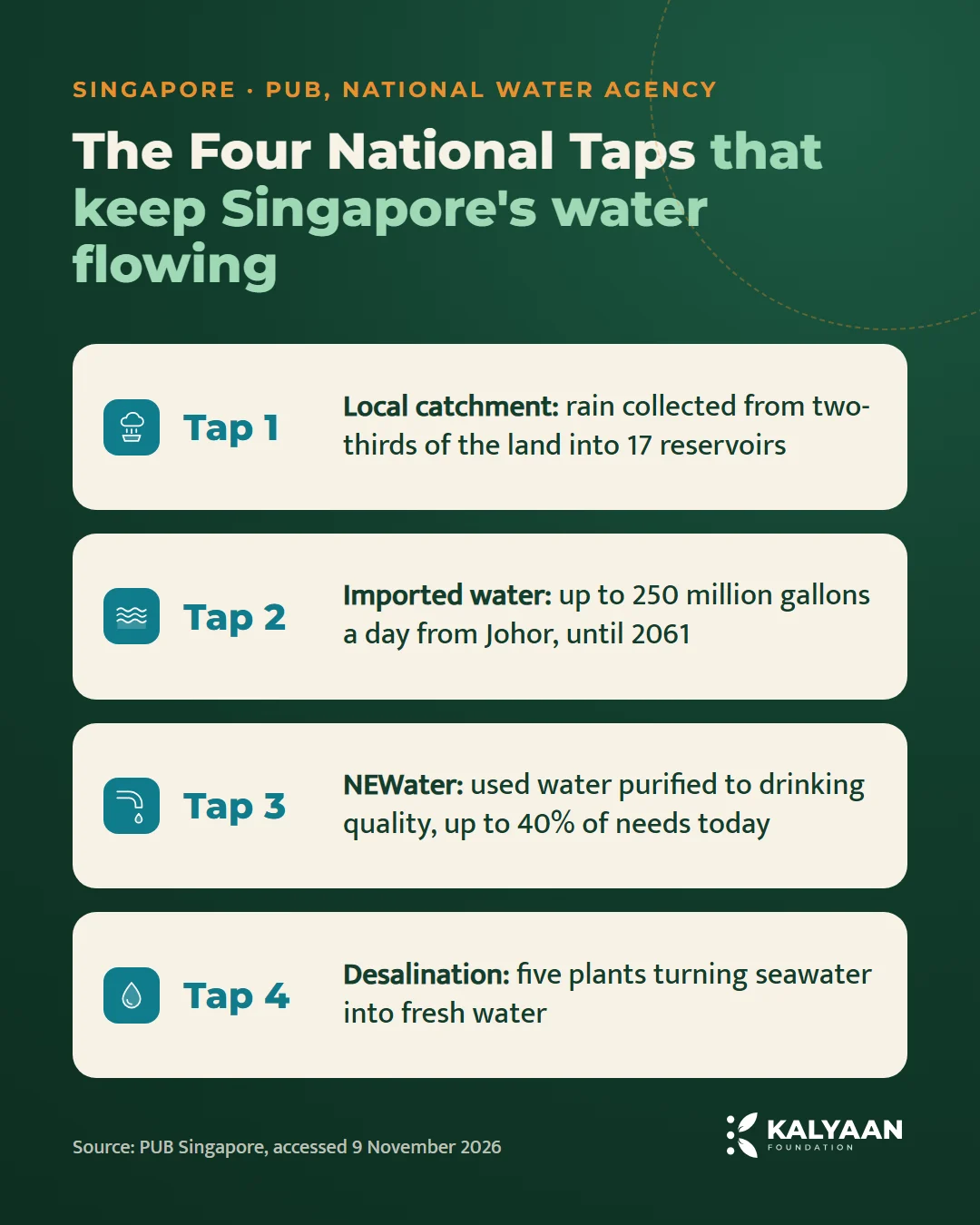
Over the last 60 years, Singapore has built a strong and diversified water supply known as the “Four National Taps”. Its tap water is well within the World Health Organization’s drinking water guidelines and is safe to drink without further filtration.
Tap 1: local catchment, a reservoir in the city
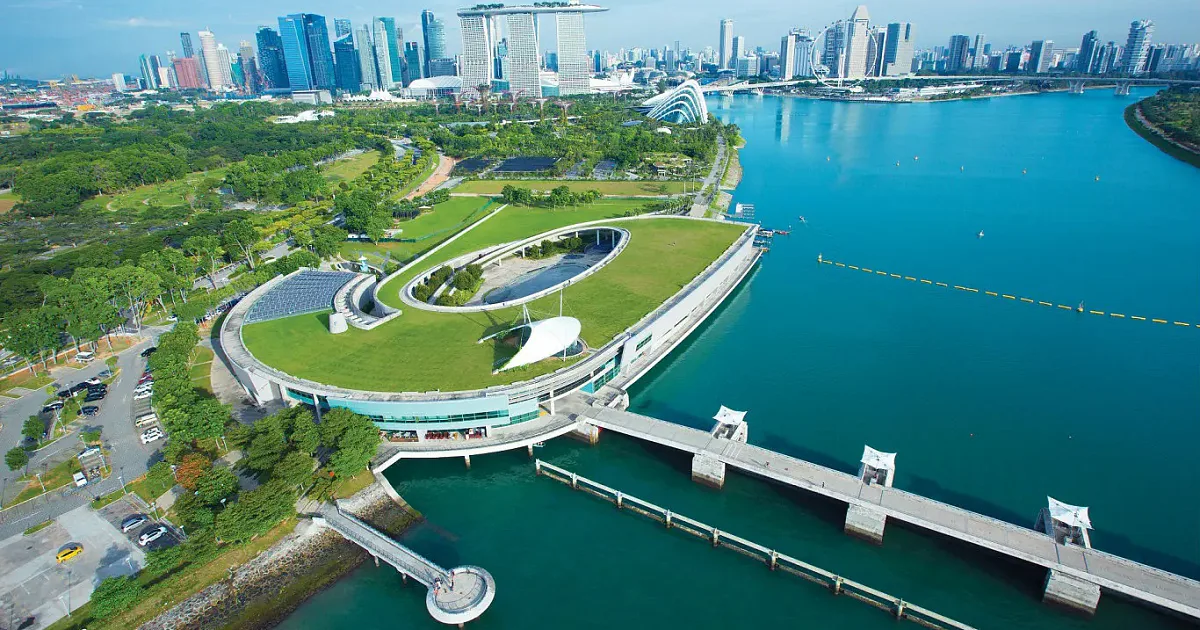
Water from local catchment is a pillar of Singapore’s supply. Since 2011, with the completion of the Marina, Punggol and Serangoon reservoirs, the water catchment area has grown from half to two-thirds of Singapore’s land surface. Rain that falls on roofs, roads and parks is channelled through drains and canals into reservoirs.
The most famous is Marina Reservoir, Singapore’s 15th reservoir, created by building the Marina Barrage across the mouth of the Marina Channel. It was the vision of Singapore’s first Prime Minister, Mr Lee Kuan Yew, to turn the city-centre bay into fresh water.
Tap 2: imported water from Johor
Singapore also buys water from the Johor river in Malaysia. The 1961 Water Agreement expired on 31 August 2011. Singapore continues to import water under the 1962 Water Agreement, which allows it to draw up to 250 million gallons a day until 2061.
Tap 3: NEWater, the used water superhighway
NEWater is Singapore’s success story and a pillar of water sustainability. It is high-grade reclaimed water: used water that has been treated and then further purified with advanced membrane technologies and ultraviolet disinfection, making it ultra-clean and safe to drink. According to PUB, NEWater can meet up to 40% of the nation’s current water needs, and by 2060 it is expected to meet up to 55% of future demand.
Used water reaches the reclamation plants through the Deep Tunnel Sewerage System (DTSS), a “used water superhighway” deep underground. Phase 1, with 48 km of deep tunnels serving eastern Singapore, was completed in 2008. Phase 2, covering the western part of the island, is expected to be completed around 2026.
Tap 4: desalinated seawater
Singapore now has five desalination plants that turn seawater into fresh water. They meet roughly a quarter of today’s demand, and desalinated water is expected to meet up to 30% of Singapore’s needs by 2060. Desalination uses a lot of energy, so PUB is working on methods that need less power.
Active, Beautiful, Clean Waters
Under the Active, Beautiful, Clean Waters (ABC Waters) Programme, launched in April 2006, reservoirs, rivers and canals do more than carry and store water. They have become community spaces for walking, boating and play, turning Singapore into a “City of Gardens and Water”. More than 100 locations have been identified for the programme by 2030. The aim is to bring people closer to water so that they value and protect it.
Citizens are part of the effort too. The Watermark Awards recognise people and organisations for outstanding work for water, and anyone keen to raise awareness or organise water activities can join as a “Friend of Water”.
Becoming a global hydrohub
Water is also an industry in Singapore. According to PUB, the government has committed S$670 million since 2006 to research in water technology, and the country is home to about 180 water companies and more than 20 water research centres. Singapore shares its experience with the world and welcomes partners to develop new solutions.
What India can learn from Singapore
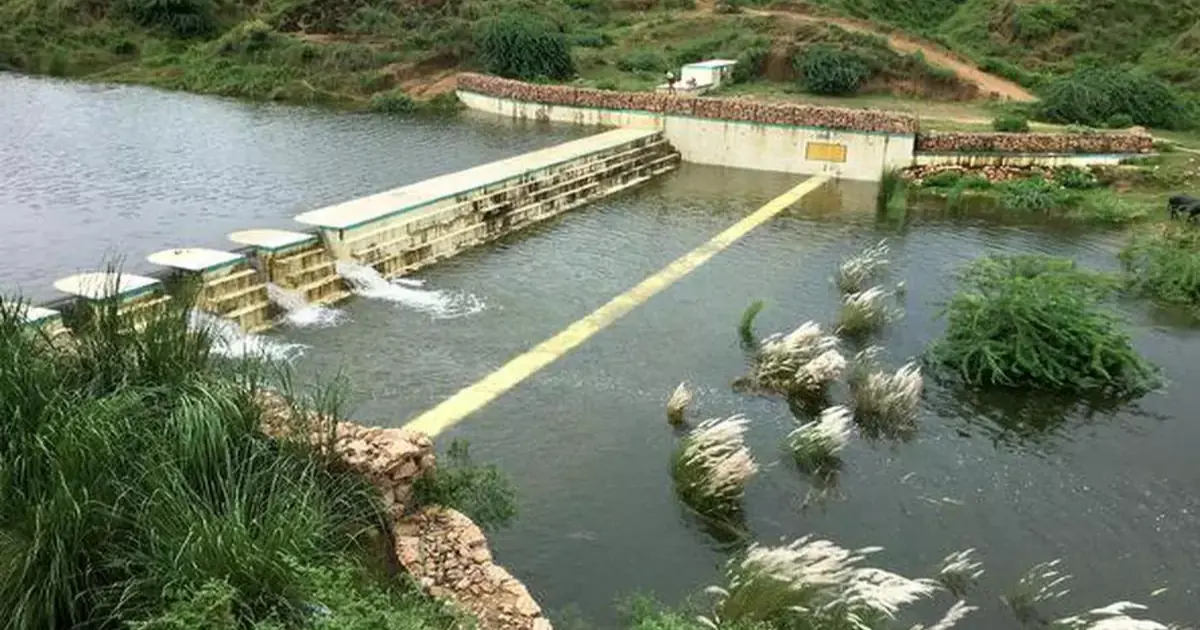
India receives far more rain than Singapore, yet many of our cities and villages run dry every summer. Singapore shows that the answer is not one big project but a complete system: catch the rain, recycle used water, keep rivers clean and part of daily life, and plan for decades ahead. The same thinking is behind Kalyaan’s proposals to revive the Jawai River with check dams, to harvest rainwater in large open spaces, and the results already seen with check dams in Dholpur.
Sources
- PUB, Singapore’s National Water Agency, “Singapore Water Story” and “Four National Taps”, pub.gov.sg, accessed 9 November 2026.
- PUB, Deep Tunnel Sewerage System (Phase 1 completed 2008; Phase 2 expected 2026), pub.gov.sg, accessed 9 November 2026.
Questions and answers
What are Singapore's Four National Taps?
Water from local catchment (rain collected in reservoirs), imported water from Johor in Malaysia, NEWater (used water purified to drinking quality) and desalinated seawater.
What is NEWater?
NEWater is high-grade reclaimed water: treated used water further purified with membranes and ultraviolet light. According to PUB it can meet up to 40% of Singapore's current water needs.
Is Singapore's tap water safe to drink?
Yes. PUB states that Singapore's tap water is well within the World Health Organization's drinking water guidelines and can be drunk without further filtering.
What can India learn from Singapore's water management?
Treat every drop of rain as a resource, recycle used water, keep rivers and lakes clean and part of public life, and plan water for decades ahead with one agency responsible.