 Agroforestry

Behind every cup of tea and coffee lie India’s hills. Plantations have replaced native grasslands and forests in the Nilgiris, Assam and the Western Ghats, pushing elephants, gaur and tigers into villages. This post explains the hidden ecological cost of tea and sun-grown coffee, and why shade-grown coffee shows that farming and forests can live together.
The High-Altitude Crisis
For centuries, humans have cleared the plains for agriculture. Now, that destruction has reached India’s most vital hills and mountains. Tea and coffee estates, once sole symbols of regional prosperity, are increasingly recognized as primary drivers of:
-
Massive deforestation.
-
Wildlife displacement.
-
Severe ecological imbalance.
It is high time we prioritize restoring hilly jungles and building a sustainable balance between ecology and human settlement.
Tea estates: green deserts in the Nilgiris and Assam
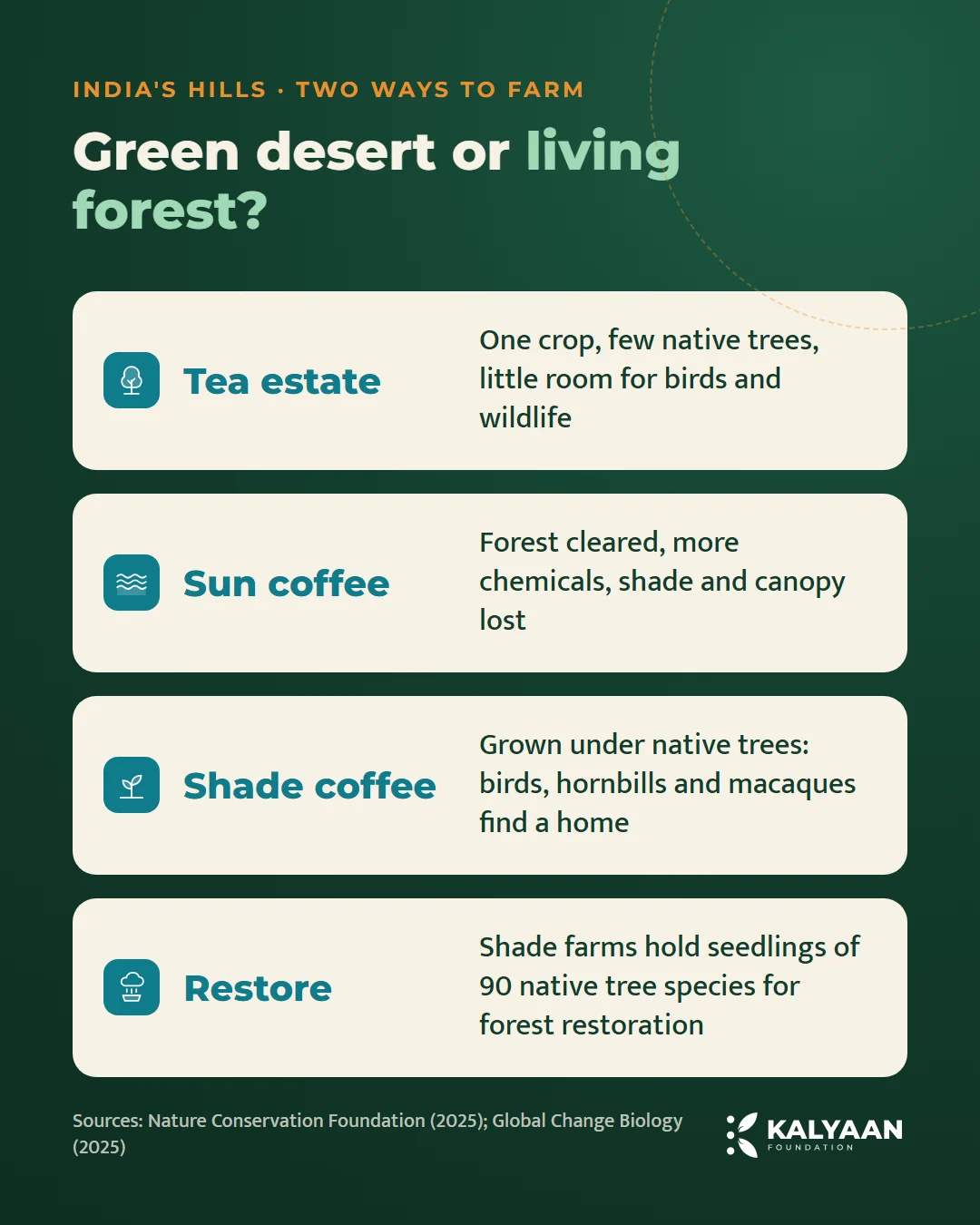
While they look lush, conventional tea estates are often “green deserts”—monocultures that support very little biodiversity.
The ecological impact of tea
-
Lost forests and grasslands: A 2025 study in Global Change Biology found that the Nilgiris have lost about 80% of their native grasslands, largely to tea and timber plantations, and native birds such as the Nilgiri pipit declined sharply.
-
Severe Wildlife Displacement: Elephants, gaur, and tigers are forced into human settlements as critical wildlife corridors, like the Sigur Elephant Corridor, are fragmented.
-
Human-wildlife conflict: Fragmentation has a human cost. An analysis of Tamil Nadu forest records found the Nilgiris to be the state’s worst hotspot for human–gaur conflict between 2016 and 2024, with 174 incidents reported.
-
Land Degradation: Monocultures strip soil fertility, significantly increase landslide risks on slopes, and pollute streams with chemical fertilizer runoff.
-
Biodiversity loss: Conventional tea estates support far fewer bird species than mixed, shaded or organic plantations.
Coffee estates: a tale of two methods
Coffee’s impact in the Western Ghats is more nuanced, depending entirely on the cultivation method.
The threat: sun-grown coffee
This modern method maximizes yield but minimizes ecological health.
-
Habitat Loss: Requires clearing native forests, leading to total biodiversity loss.
-
Chemical Use: Heavy reliance on synthetic fertilizers and pesticides.
-
Reduced Canopy: Eliminating shade cover harms bird and mammal populations.
-
Wildlife Displaced: Expansion has displaced hornbills, macaques, and endemic species, while sharply increasing human–animal encounters in Karnataka and Kerala.
The hope: shade-grown coffee
Not all coffee is destructive. Shade-grown coffee, cultivated under a canopy of native trees, offers a vital model of coexistence:
-
Supports biodiversity: Provides habitat for many bird species, hornbills, squirrels and the endangered lion-tailed macaque.
-
Reduces soil erosion: Shade trees protect fragile, steep hill slopes from erosion.
-
Carbon storage: The tree canopy stores more carbon than sun-grown coffee.
-
Forest restoration: A 2025 study by the Nature Conservation Foundation found 90 native tree species useful for restoration growing on shade coffee farms, including conservation-priority species, whose seeds and seedlings can be used to restore nearby degraded forests.
Conclusion: conscious consumption for a healthy planet
Tea and sun‑grown coffee estates have scarred India’s hills, displacing wildlife and degrading ecosystems. Shade‑grown coffee, however, shows a path forward—one where agriculture and ecology can coexist.
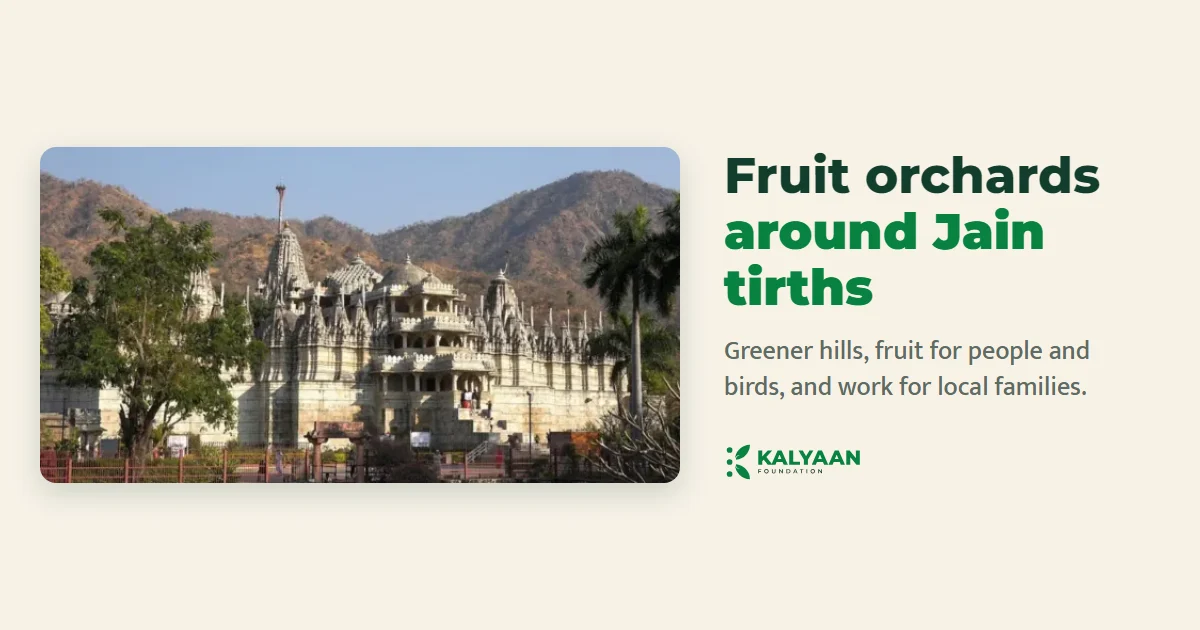
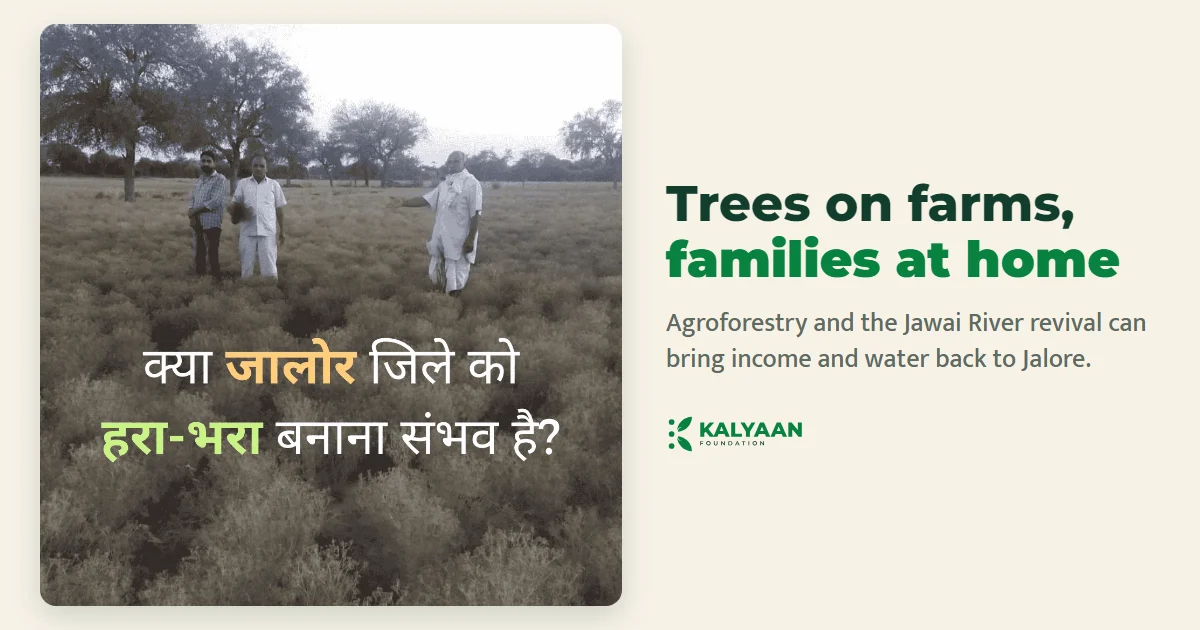
To heal our planet, we must collectively support the restoration of hilly jungles, protect wildlife corridors, and consume consciously. By choosing shade-grown products, we reduce our harm to nature. Trees and farms can live together, as agroforestry in Jalore and fruit orchards near Jain tirths show.
Urban farms feed cities. Restored lands heal the planet. Shade-grown coffee sustains both.
Sources
- Mongabay India, “Old maps and dead birds reveal the story of grassland and bird decline in the Nilgiris” (August 2025), on a study in Global Change Biology, india.mongabay.com, accessed 9 November 2026.
- Mongabay India, “Coffee agrofarms can play a key role in restoring degraded forest, study says” (April 2025), Nature Conservation Foundation, india.mongabay.com; dataset: Dryad, accessed 9 November 2026.
- Study of human–gaur conflict in Tamil Nadu, 2016–2024 (forest division compensation records), preprint, Research Square, accessed 9 November 2026.
Questions and answers
What is the hidden cost of tea?
Tea estates replaced native forests and grasslands on India’s hills. The result is less biodiversity, broken wildlife corridors, more human–wildlife conflict, soil loss and chemical runoff into streams.
Why are tea estates called green deserts?
They look green, but a single crop with few native trees supports very little wildlife compared with the forests and grasslands it replaced.
What is shade-grown coffee?
Coffee grown under a canopy of native trees instead of on cleared land. It keeps habitat for birds and animals, protects slopes from erosion and stores more carbon.
How can consumers help?
Choose shade-grown and responsibly grown tea and coffee, support restoration of hill forests and wildlife corridors, and avoid wasting what we buy.