
🌆 Urban Vertical Farming: Feeding Cities, Restoring Nature

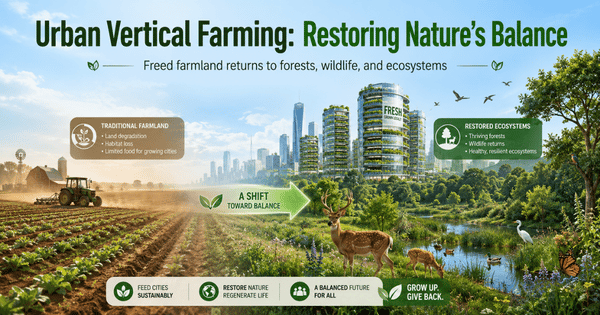
As cities expand and farmland shrinks, humanity faces a dual crisis: how to feed growing populations while restoring ecosystems. Urban vertical farming — multi‑layered, high‑tech agriculture integrated into city infrastructure — offers a revolutionary solution. By producing food where people live, we can reduce land and water use, cut emissions, and return vast agricultural areas to nature.

The Scale of the Challenge
A city of 25 lakh people requires approximately 5 to 6 lakh tons of vegetables annually.
Traditional farming demands 20,000 to 25,000 hectares of land to meet this need.
Vertical farming can reduce land use by 95%, requiring only ~1,000 hectares equivalent in stacked layers.
Hydroponic and aeroponic systems cut water consumption by 90–95%, saving billions of liters every year.
Benefits of Multi‑Layer Urban Farming Complexes
Space Efficiency: Crops grown in stacked layers maximize productivity per square meter.
Year‑Round Harvests: Controlled environments allow continuous production, independent of climate.
Cleaner Cities: Local food reduces transport emissions by up to 70–90%.
Nutrition Gains: Studies show vertical farm produce can have 15–30% higher nutrient density.
Livelihood Creation: Opens opportunities for urban farmers, startups, and NGOs.
Technology Integration for Sustainability
Natural Sunlight Tubes: Aluminium reflective pipes transmit daylight into farm layers, reducing LED dependence.
Waste Heat Recovery: Urban buildings heat can recycle wastewater, making hydroponics more efficient.
Circular Systems:
Food waste → biogas + organic fertilizer.
Urban dairies integrated for protein supply.
Greywater recycled for irrigation.
IoT & AI: Sensors optimize nutrients, lighting, and climate control, ensuring maximum efficiency.

Ecological Restoration Potential
Land Return: Freeing 20,000 hectares of farmland allows rewilding into forests, wetlands, and grasslands.
Biodiversity Corridors: Restored land reconnects fragmented habitats, supporting wildlife.
Carbon Sequestration: Rewilded land absorbs CO₂, while local farming cuts transport emissions.
Water Security: Reduced agricultural water demand strengthens resilience against droughts.
Challenges Ahead
Energy Demand: LED lighting and HVAC systems remain costly unless powered by renewables.
Crop Diversity Limits: Current systems excel at leafy greens, herbs, and some fruits; grains and pulses are harder.
Capital Costs: High upfront investment, with ROI typically in 5–7 years.
Policy Gaps: Urban zoning, subsidies, and training programs are essential for scaling.
Conclusion
Urban vertical farming is more than a food solution — it’s a pathway to restore ecosystems, reduce emissions, and empower communities. For a city of 2.5 million, the shift could free tens of thousands of hectares, save billions of liters of water, and cut transport emissions drastically.


Comments