 Environment
Diwali is the festival of light, yet every year a few hours of firecrackers leave our cities under a grey haze. This article looks at what this year's Diwali did to the air we breathe, what a cracker really releases, how it harms the tiny living world in the air, soil and water, and what Jain teaching on fire says about it, with simple ways to celebrate brightly without the damage.
Diwali is the festival of light. It celebrates the victory of light over darkness and of knowledge over ignorance. Yet every year, the night after the lamps are lit, a few hours of firecrackers leave our cities under a grey haze that takes days to clear. This article looks at Diwali air pollution in plain words: what happened this year, what a single cracker releases, how it harms the living world we cannot see, and how we can keep the joy of the festival without the damage.
What this Diwali did to our air
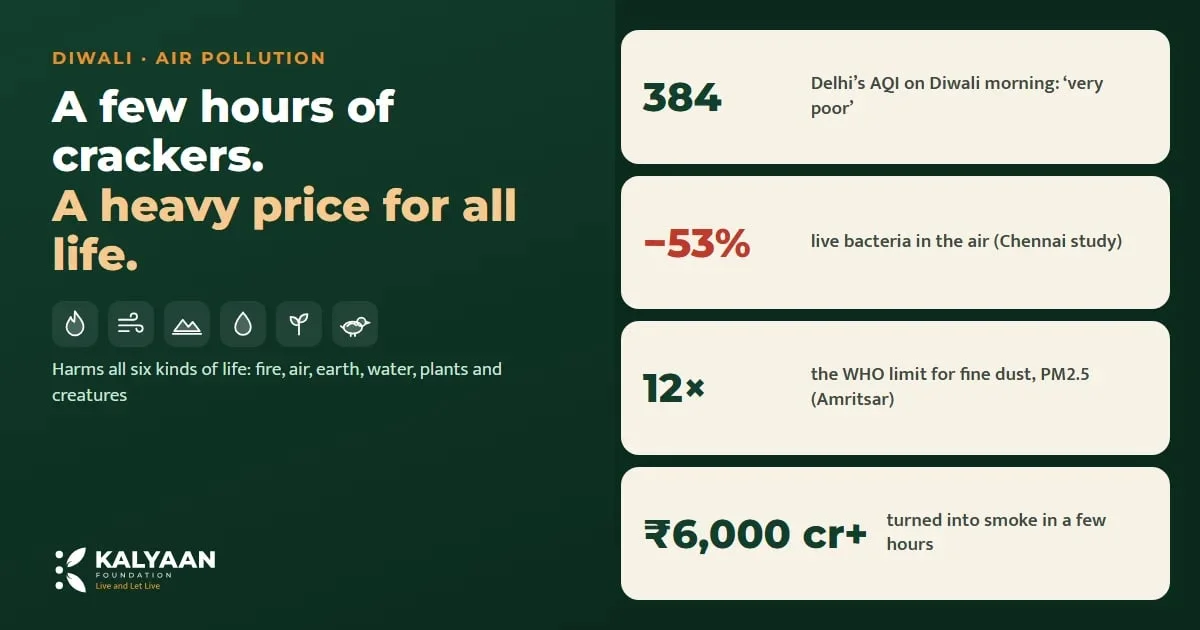
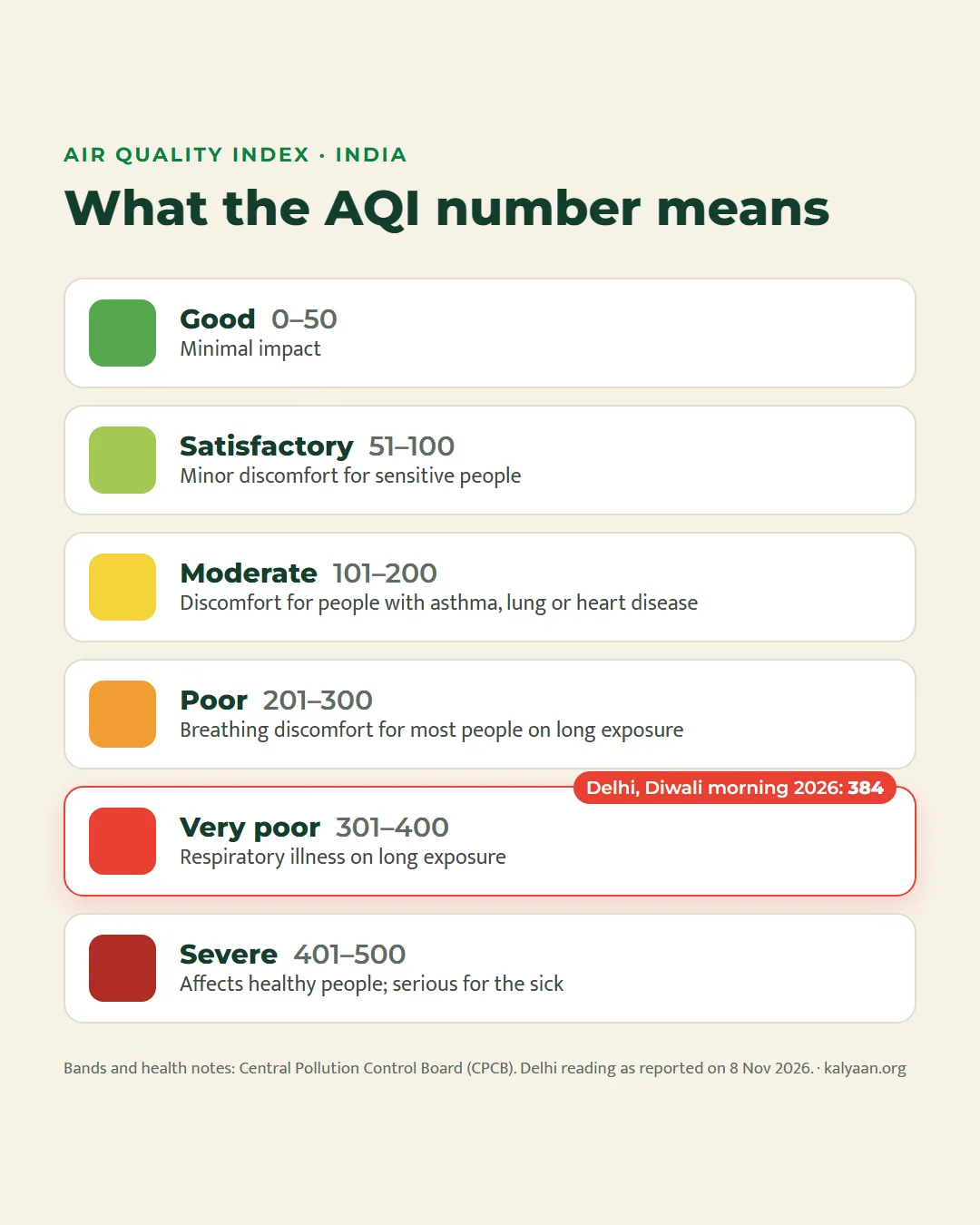
This year Diwali fell on Sunday, 8 November 2026. On Diwali morning, Delhi’s average Air Quality Index (AQI) was reported at 384, in the “very poor” band, and more than twenty monitoring stations crossed 400, the “severe” mark. Mumbai, with sea breezes, stayed “moderate”.
Gujarat was not spared. Readings from a private sensor network (AQI.in, which uses a different scale from the government’s) showed Vadodara and Rajkot above 1,000 and Ahmedabad around 636 near midnight on Diwali night. The exact numbers differ by source and time, but the direction is the same everywhere: within a few hours, the air turned from breathable to harmful.
India’s AQI has six bands. Up to 100 is good or satisfactory. Above 200 is “poor”, above 300 “very poor” and above 400 “severe”, when even healthy people feel the effect and those with asthma, heart or lung disease suffer most.
What one cracker releases
A firecracker is a small packet of fuel, oxidiser and colouring chemicals. When it burns, it throws out:
- Fine dust (PM2.5): particles about 30 times thinner than a hair. They go deep into the lungs and can enter the blood.
- Gases: sulphur dioxide, nitrogen oxides and carbon monoxide, which irritate the eyes, throat and lungs.
- Metals: the colours come from metal salts. Studies during Diwali have repeatedly found more barium, strontium, copper and aluminium in the air; in Amritsar, metals made up nearly a quarter of the fine dust on Diwali day.
For comparison, the World Health Organization’s guideline for PM2.5 over 24 hours is 15 micrograms per cubic metre, and India’s own standard is 60. A study in Amritsar measured 182 on Diwali day, three times the Indian limit and twelve times the WHO guideline. In early winter the air is cool and still, so this smoke stays close to the ground, where we breathe it.
The air is alive
We usually think of air as empty. It is not. Every cubic metre of city air carries thousands of tiny living cells: bacteria, fungal spores and other microbes. Together with the microbes in soil and water, they form a living web, the microbiome, that breaks down waste, keeps soil fertile and is part of the balance of life around us.
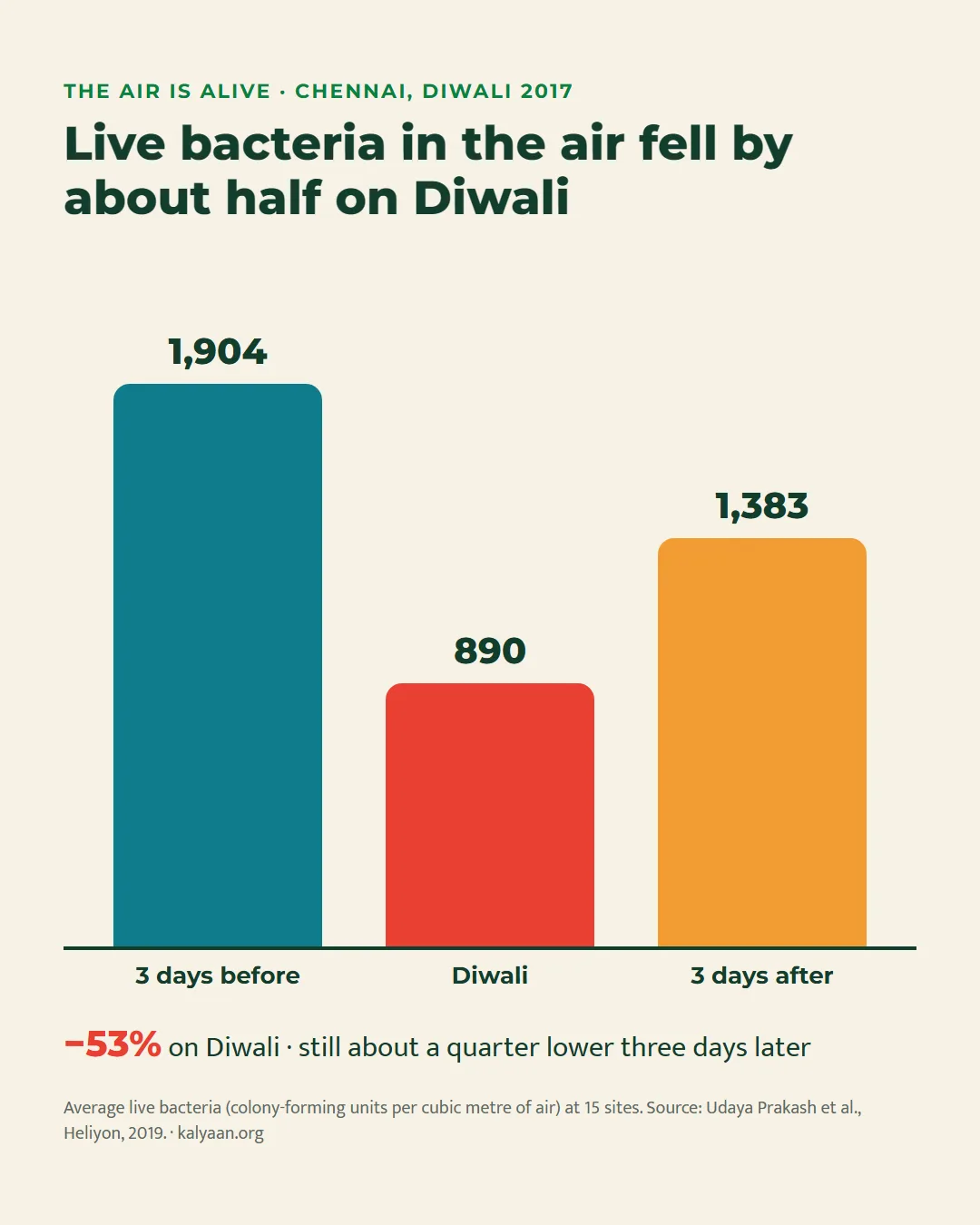
Crackers strike this living world directly. In 2017, scientists in Chennai sampled the air at 15 places three days before Diwali, on Diwali and three days after. The number of live bacteria in the air fell by about 53% on Diwali, and at one site by 98%. Three days later it was still about a quarter below normal. The researchers linked the fall to the chemicals released by the crackers. A study in China during the Spring Festival also found that firework smoke changed which kinds of bacteria lived in the air.
What Jain teaching says about fire
Long before microscopes, Jain thinkers taught that the world is full of life far beyond what the eye can see. The Acharanga Sutra and the Dashavaikalika Sutra describe six kinds of living beings (षट्जीवनिकाय): earth-bodied (पृथ्वीकाय), water-bodied (अप्काय), fire-bodied (अग्निकाय or तेउकाय), air-bodied (वायुकाय) and plant beings (वनस्पतिकाय), which have one sense, and moving beings (त्रसकाय) such as insects, birds, animals and people.
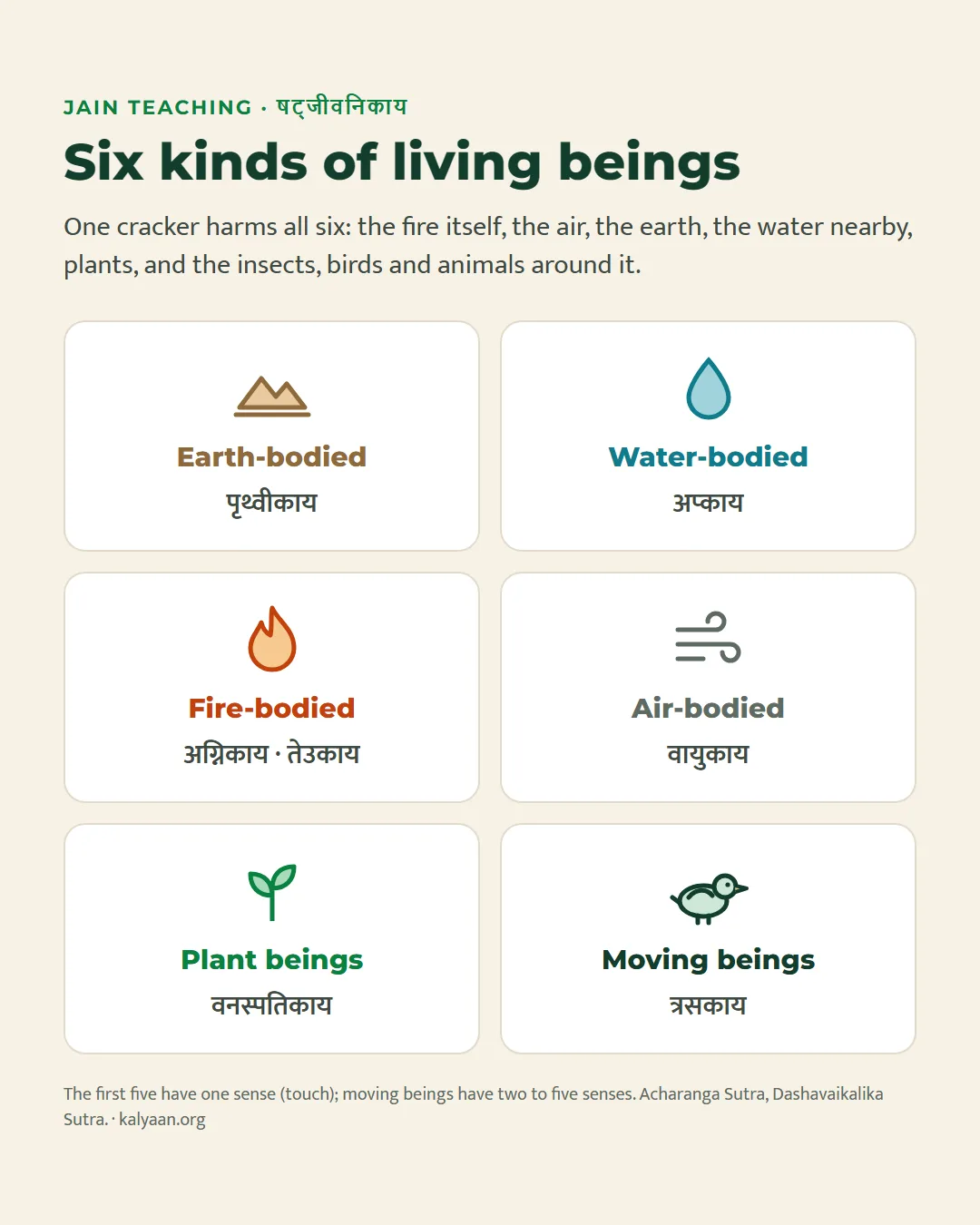
In this teaching, fire is itself a living body. Lighting a cracker brings countless fire-bodied beings into being and destroys them within moments. Its heat, smoke and chemicals then harm the air-bodied beings around it, the earth-bodied beings where the paper and powder fall, and the water-bodied beings in the nearby pond or lake where the smoke settles. Insects drawn to the light, birds shaken from their nests and frightened animals suffer too. For a few seconds of noise and colour, every one of the six kinds is hurt.
This is why many Jain families have long avoided crackers. It follows from the heart of Jain ethics, non-violence (अहिंसा) towards all living beings, and from the principle that guides Kalyaan: Live and Let Live. Science and scripture use different words, but they point the same way: the air, the soil and the water are alive, and a cracker harms that life.
The cost of a few hours
The damage does not end when the smoke clears.
- Money: India’s main cracker hub, Sivakasi, reported Diwali sales of about ₹6,000 to 7,000 crore in 2025. That is money turned into smoke within a few hours.
- Health: hospitals see more asthma attacks, coughs and breathing problems after Diwali, and families spend on doctors and medicines.
- Injuries: one Delhi hospital treated 1,373 people for cracker injuries over nine Diwalis, most of them young. In another eye hospital study, one in three injured eyes needed surgery.
- Birds and animals: vets and rescuers report many more injured birds every Diwali, and pets and street animals hide in terror from the noise.
- Noise: loud bursts far exceed the limits set for homes. Our article on no honking and healthy living explains how noise alone harms health.
- Waste: burnt paper, plastic and chemical residue are left on streets and in drains, and wash into ponds and rivers.
A small fun of a few hours leaves a long bill, paid by everyone, including those who never lit a cracker.
A brighter way to celebrate
Diwali is a festival of light, not of smoke. Some simple ways to celebrate it fully:
- Light diyas and lamps. Clay diyas and electric lights carry the real meaning of the festival.
- Share instead of burn. Spend the cracker budget on sweets, gifts or help for a family in need.
- Celebrate together. A community light show or a rangoli evening brings more joy than many small bursts.
- Plant something. Use the money for a fruit tree that will give shade and fruit for years.
- Protect the vulnerable. If crackers are burst around you, keep children, the elderly and pets indoors, and follow local rules on time limits and “green” crackers.
Diwali falls on Amavasya, the darkest night of the month. Our Moon Calendar article explains how that date is worked out. Let us light that darkness with lamps, not smoke.
Sources
- Delhi and Mumbai AQI on Diwali 2026: The Quint, 8 Nov 2026
- Gujarat readings on Diwali night 2026 (AQI.in sensors): Gujarat Samachar, 9 Nov 2026
- Airborne bacteria and fungi during Diwali, Chennai: Udaya Prakash et al., Heliyon, 2019
- Metals and PM2.5 during Diwali, Amritsar: source apportionment study
- WHO 2021 air quality guidelines and India’s standards: Down To Earth
- Cracker injuries in Delhi: Tandon et al., Indian Journal of Plastic Surgery, 2012
- Sivakasi sales: IBTimes India
- Six kinds of living beings: Jainpedia, ṣaṭ-jīvanikāya
Questions and answers
Why does air pollution rise after Diwali?
Firecrackers release fine dust (PM2.5), gases such as sulphur dioxide and tiny particles of metals into the air within a few hours. In early winter the air is cool and still, so the smoke stays close to the ground for a day or more.
What is a safe AQI?
In India's AQI, 0 to 50 is 'good' and 51 to 100 is 'satisfactory'. Above 200 is 'poor', above 300 'very poor' and above 400 'severe', when even healthy people are affected.
Do firecrackers harm microbes in the air?
Yes. A study in Chennai sampled the air at 15 places before, on and after Diwali 2017. Airborne bacteria fell by about 53% on Diwali, and at one site by 98%; three days later they were still about a quarter below normal.
What does Jainism say about firecrackers?
Jain teaching describes six kinds of living beings, including fire-bodied beings (agnikaya) and air-, earth- and water-bodied beings. Lighting a cracker harms all of them, along with insects and birds, so Jains avoid needless fire as a matter of non-violence (ahimsa).
How can we celebrate Diwali without crackers?
Light diyas and electric lamps, share sweets, gather for a community light show, decorate with rangoli and flowers, and use the money saved for something lasting, such as planting a fruit tree or helping a family in need.