
 Vedic Sciences
Hindu festivals, fasts and Jain parva days follow the Moon, not the English calendar. This article explains what a tithi (moon date) is, why it almost never starts at midnight, and how to find the exact tithi start and end time for your own city with Kalyaan's free Moon Calendar.
In India we live by two calendars. The English calendar runs our offices and schools, but our fasts, festivals, weddings and Jain parva days follow the Moon. The moon date is called a tithi, and a common question every morning is simple: which tithi is it today, and from when to when does it run? This article explains the tithi start and end time in plain words, and shows how to check it for your own city.
What is a tithi
A tithi is one lunar day. Seen from the Earth, the Moon moves ahead of the Sun by about 12 degrees in roughly a day. Each 12-degree step is one tithi. A full circle is 360 degrees, so one lunar month has 30 tithis.
Shukla paksha and Krishna paksha
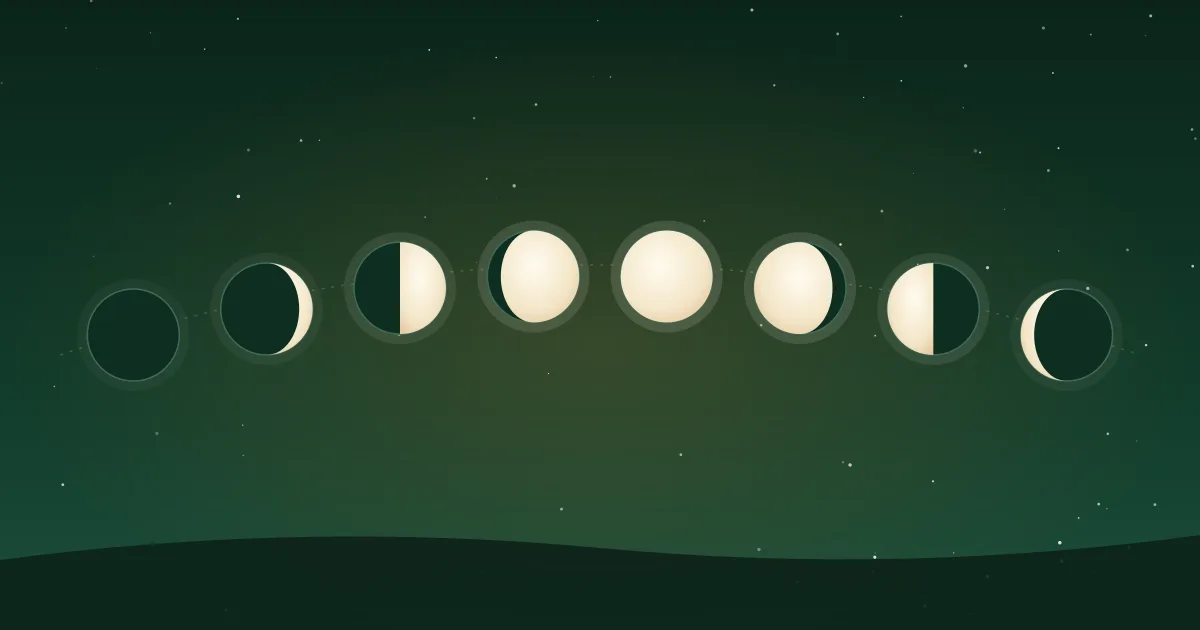
The 30 tithis are split into two halves of 15. In Shukla paksha, the bright half, the Moon grows from new moon to full moon, ending on Purnima. In Krishna paksha, the dark half, it shrinks back, ending on Amavasya. The tithis in each half have the same names: Pratipada, Dwitiya, Tritiya and so on up to Chaturdashi, followed by Purnima or Amavasya.
Why the tithi start and end time changes every day
An English date always runs from midnight to midnight. A tithi does not. It begins the moment the Moon reaches the next 12-degree step, and that can happen at 4 in the morning, at lunch time or late at night.
The Moon also does not move at a steady speed. Its orbit is an ellipse, so it moves faster when it is closer to the Earth and slower when it is farther away. That is why a tithi can be as short as about 19 hours or as long as about 26 hours. Two tithis can fall on the same English date, and one tithi can run across two dates.
The tithi at sunrise (udaya tithi)
Because a tithi can start at any hour, families need a rule for which tithi “belongs” to a day. Most traditions follow the udaya tithi: the tithi running at sunrise. A fast for Ekadashi, for example, is usually kept on the day when Ekadashi is running at sunrise.
This rule creates two special cases:
- A skipped tithi (kshaya tithi): a short tithi that starts after one sunrise and ends before the next is never present at sunrise.
- A doubled tithi (vriddhi tithi): a long tithi that is present at two sunrises in a row belongs to two days.
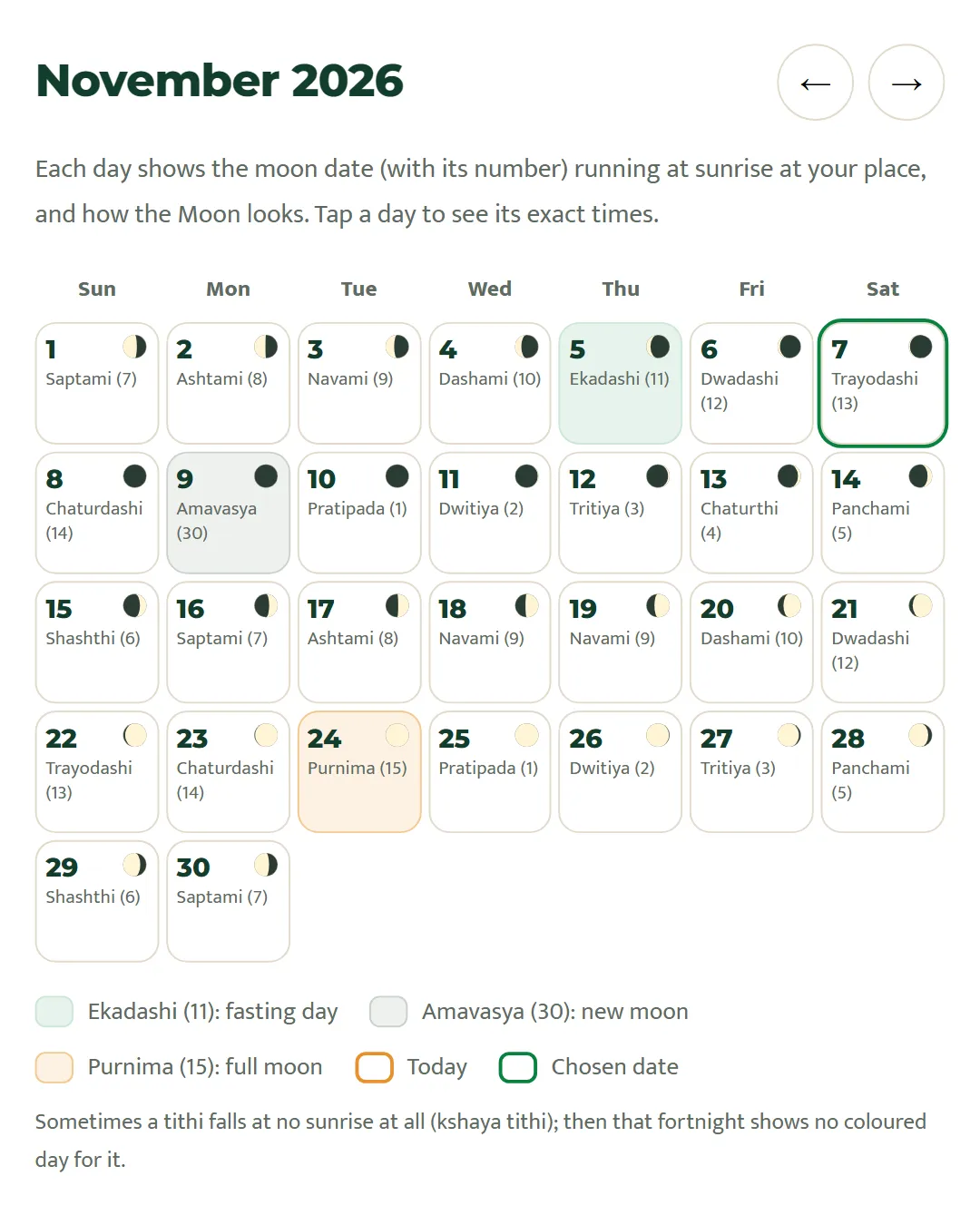
You can see both in the month view further below: in November 2026 at Ahmedabad, Navami is at sunrise on the 18th and the 19th, while Ekadashi is at no sunrise at all.
Sunrise differs from city to city, so the sunrise tithi can differ too. It is always worth checking for your own place. Your family priest or your own tradition has the final word on which day to observe.
Purnimanta and Amanta months
Both systems use the same tithis but end the month on different days. In the Purnimanta system, followed in Rajasthan and most of North India, the month ends on Purnima. In the Amanta system, followed in Gujarat, Maharashtra and the South, the month ends on Amavasya. During Krishna paksha the month name is therefore one apart: the same night can be Kartik in one system and Ashwin in the other. Some years also have an extra month, called adhik maas.
How to use the Moon Calendar
Kalyaan’s Moon Calendar answers the daily question in one look:
- Open the page. It finds your approximate place by itself. You can also search for any city in the world.
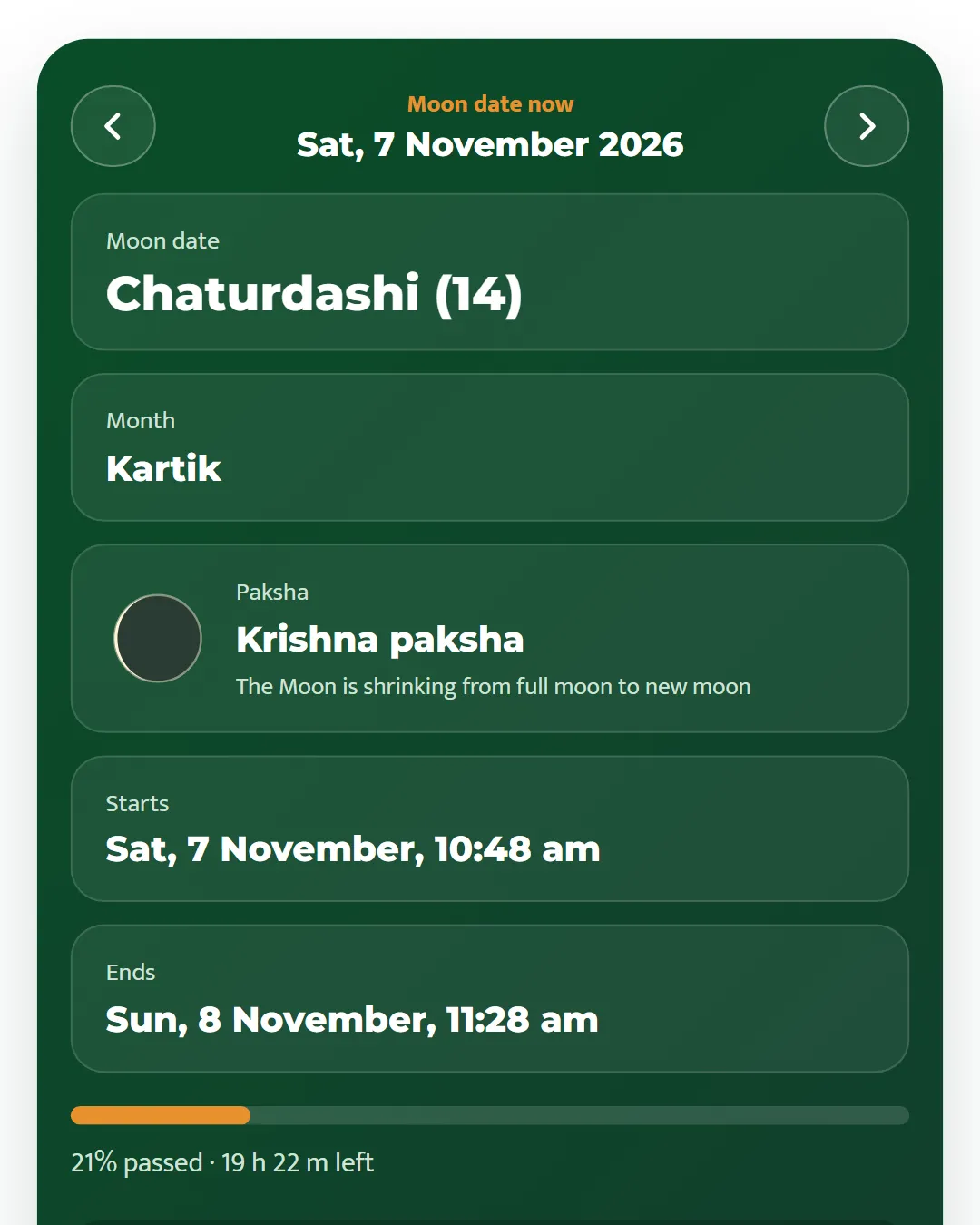
- Read today’s tithi. You see its exact start and end time in your place’s own time zone, the paksha with a drawing of the Moon, and the Hindu month in both Purnimanta and Amanta.
- See every tithi of the date. If two tithis fall on one date, both are listed and the sunrise tithi is marked.
- Check the nakshatra. The ruling nakshatra (one of 27 star groups) is shown with its own start and end time.
- Plan ahead. Use the arrows to move day by day, see the next few tithis, or open the month view with a colour key.
The whole page works in Hindi and English with one tap.
How the times are calculated
The Moon Calendar does not copy times from another website. It calculates the positions of the Sun and the Moon on your own device with Astronomy Engine, a free and open-source astronomy library. Nakshatras use the Lahiri (Chitrapaksha) ayanamsa, the standard used in India’s official Rashtriya Panchang.
We compared the results with an established reference for several dates in 2026 and 2027, and they agreed within about a minute. Because everything is calculated, the calendar works for any year and needs no yearly update. It is free, needs no sign-up and stores nothing about you.
Why Kalyaan built it
Our guiding idea is “Live and Let Live”. For thousands of years people in India have planned sowing, festivals and gatherings by the Sun and the Moon. Vedic sciences, from the calendar to Vastu, grew from close observation of nature, the same spirit behind our work on water, trees and towns. Our article on Vastu principles in modern city planning shows another side of this old knowledge, and fruit orchards near Jain pilgrimage sites looks at places that come alive on festival days.
The Moon Calendar is the first piece of our new Vedic Sciences section. More articles will follow. Until then, keep it open for your next fast or festival.
Questions and answers
What is a tithi?
A tithi is one lunar day: the time the Moon takes to move 12 degrees ahead of the Sun. A lunar month has 30 tithis, 15 in Shukla paksha (bright half) and 15 in Krishna paksha (dark half).
How long is a tithi?
Between about 19 and 26 hours. The Moon's speed along its orbit changes, so some tithis are much shorter than a day and some are longer.
Which tithi counts for a fast or festival?
Most traditions follow the udaya tithi, the tithi running at sunrise. The Moon Calendar marks the sunrise tithi for your city on every date.
Why do tithi times differ from city to city?
The tithi changes at the same moment everywhere, but the clock time depends on your time zone, and the sunrise tithi depends on your local sunrise. That is why the Moon Calendar asks for your place.
Is the Kalyaan Moon Calendar free?
Yes. It is free, needs no sign-up and stores nothing about you. It works for any place in the world and for any year.